
Dougherty Property Value Types
Several numbers live inside a Dougherty property record. Each was created for a different purpose. The year and the source matter as much as the amount itself. The Board of Assessors values property and prepares the digest, while the Clerk records deeds and other transfer evidence.
| Value type | Meaning | Official record |
|---|---|---|
| Fair-market value | Assessor's estimate under Georgia valuation rules | Assessment notice and property record |
| Assessed value | The assessment-level amount used in the tax framework | Board of Assessors record |
| Sale consideration | Amount associated with a recorded transfer where indexed | Deed and GSCCCA transfer data |
| Land and improvements | Separate components for site and structures | Assessor value detail when available |
Georgia assesses most non-exempt real property at 40 percent of fair-market value. Qualified agricultural property can use a 30 percent framework instead. Exemptions change taxable exposure, not market price. A sale may also reflect timing, condition, or financing. It may also reflect family circumstances that mass appraisal does not model.
Georgia's Dougherty Assessment Level
The assessment ratio is the share of fair-market value carried into assessed value. Picture a $100,000 fair-market estimate. At 40 percent, that yields $40,000 assessed value. That arithmetic runs before any exemption or tax calculation. The illustration is math, not a valuation of any parcel. Do not reverse the ratio blindly. A record may carry a special-use classification or an exemption. Verify the year, class, homestead status, and labels shown on the notice. The assessor's official page is the proper source when a property's treatment is unclear.
Check a Dougherty Property Value
Dougherty County links the Schneider qPublic search as its assessor portal. It is the county's online property search. Field names can vary, so trust the labels a live result shows.
- Open Dougherty qPublic from the Board of Assessors page.
- Search the address or parcel using the live options.
- Record the fair-market, assessed, land, and improvement figures with their year.
- Check the deed trail for recorded sale consideration where available.
- Compare sources only after matching parcel and legal description.
- Assessed value
- The ratio-based assessment amount, before considering all bill calculations.
- Fair-market value
- The assessor's estimate of value under state standards.
- Assessment ratio
- The percentage linking fair-market and assessed amounts.
- Sale consideration
- The amount reported with a transfer, which may not equal current market value.
- Reassessment
- A new review or update of values for the tax roll.
Dougherty's 2026 Revaluation
Dougherty County called 2026 its first countywide revaluation in more than ten years. Notices went out the week of August 19, 2026. Each notice showed current fair-market value, homestead information, and the deadline for an individual appeal. The valuation baseline shifted. A sharp jump from the prior year can appear even without a sale or major improvement. Compare the same field across years. Read the notice date first. The county's official revaluation explanation shows the notice and value process in context.
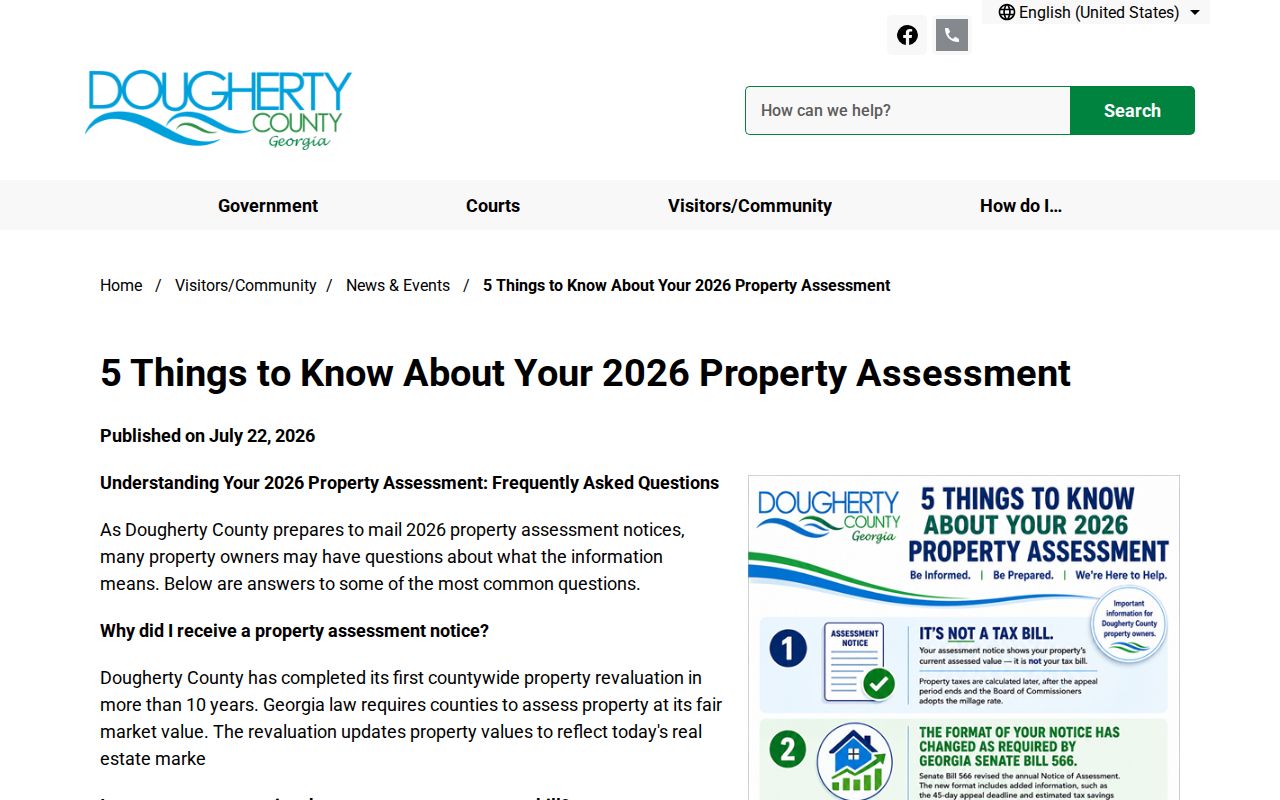
The countywide process is one thing. For a parcel's assessed value and deadline, the notice itself remains the controlling source.
Dougherty Notice Before Tax Bill
An assessment notice is not a tax bill. The county's sequence runs notice, appeal period, digest finalization, later millage decisions, and then billing. A value can be official for review while the final bill amount is still unknown. Value questions belong with the Board of Assessors at 240 Pine Avenue or 229-431-2130. The Tax Department collects the resulting bill. Bill mechanics and appeals are covered on the Dougherty County property tax records page.
Dougherty Land and Improvements
A property value often splits into two parts. Land covers the site itself. Improvements are the buildings and taxable additions the assessor records. Together they explain why two nearby parcels with similar acreage can carry very different totals. When the live card shows both components, copy each figure with its tax year. Keep the GIS footprint out of it. A building outline is not the assessor's improvement value.
Dougherty Sale Value Evidence
A recorded deed establishes a conveyance. GSCCCA indexes sales data and transfer-tax information where available, with party names, book/page, property location, and images under account rules. The local Clerk portal makes remote images free. Sale consideration is historical evidence, not an annual assessment. Confirm the deed covers the parcel you care about. A quitclaim, estate distribution, multi-parcel instrument, or family transfer is rarely a sound comparison.
Dougherty Exemptions Shift Taxable Value
Homestead and other qualified exemptions can reduce taxable exposure. They do not prove a home's market worth fell. The 2026 notices included homestead information and estimated savings. They also described state-law changes noted by the county. Keep exemption status in a separate column when comparing parcels. Otherwise a tax-related difference may look like a difference in the land or buildings. Qualification and filing questions belong to the Board of Assessors. The current notice controls the parcel's deadline.
Compare Dougherty Values Carefully
Nearby sales offer context only after adjusting for date, parcel size, building condition, legal interest, and whether each transfer was arm's length. No verified neighborhood trend series covers Dougherty County or Albany. Build context from genuinely comparable transfers instead. Use several of them. Keep the assessor year the same across comparisons. A price recorded years earlier and a fresh countywide revaluation measure different moments, and neither alone predicts today's negotiated price.
Track Dougherty Values by Year
Compare one year to the next only when the parcel stays the same. The value field must match too. For every tax year, write down the fair-market estimate, the assessed amount, the land and improvement components, the exemption status, and the notice date. Then look for the story behind the numbers. A recorded deed, a permit, or a split can explain a jump in the series. A new addition can too. The 2026 countywide revaluation makes this habit matter even more in Dougherty County. A big swing from 2025 may reflect that review rather than any sale. And a matching assessed amount across two years proves nothing about open-market price. Tax-roll values are administrative snapshots, each tied to its own year.
Dougherty Value Access Channels
qPublic is the fastest entry point for Dougherty County property records. It is not the only one. The Board of Assessors answers questions at 240 Pine Avenue. It also takes phone calls at 229-431-2130 and email at docoassessor@dougherty.ga.us. Those direct channels help when the portal is blocked. They also cover an older missing assessment year, or a label that needs an official explanation. For recorded sale evidence, the Dougherty Clerk's Tyler real-estate portal offers remote data and images at no charge. The statewide GSCCCA index works as a fallback for names, book/page entries, property data, and images. Its account rules still apply. Georgia Archives tax digests reach further back. Surviving series can list the owner of record, district, valuation, exemption, address, and taxable value. Every source measures its own period. Each answers a different question about the same parcel.
Date Every Dougherty Value
Dollars alone do not make a value worksheet useful. Record the parcel key and legal description first. Note the value label, tax year, and notice date too. Add the source URL or office, plus the date you accessed it. For sale evidence, add the recording date, deed type, grantor, grantee, and book/page. That discipline stops a mix-up. A 2026 assessment will not be mistaken for a 2023 sale on identical terms. Conflicting figures usually measure different things. Check first whether each number is fair-market, assessed, taxable, land, improvement, or consideration. Then check the year. Most contradictions vanish once record type and period line up. Take any true conflict to the Dougherty County office that created the figure.
Dougherty Property Value Limits
Dougherty County runs assessments on a mass-appraisal model built for consistent tax administration. That is not a private inspection. No assessor prices one property for one buyer on one date. Interior condition, seller concessions, financing terms, and a fast-moving market can all escape the public figure on the tax roll. GIS maps add spatial context, not value proof. Parcel lines are not a survey. Building footprints or aerial layers may carry different dates than the appraisal data. For a purchase, an estate, or any decision needing a present opinion, hire a qualified appraiser. Verify the underlying property records first.
Value is not price. Dougherty County assessed value supports taxation. It is neither a guaranteed sale price nor a property-specific appraisal.