
Dougherty Former-Owner Trail
A backward search starts with a transfer. You must tie it to the same piece of ground. The Dougherty County Clerk of Superior Court Real Estate Division is the custodian. Its holdings include deeds, grantor and grantee indexes, liens, plats, and record images. For online work, the local Tyler portal is the first stop. Remote record data and images are free there. The portal publishes no historical beginning year. The depth of its online deed records stays an open question.
| Trail source | Verified reach | Custodian | Ownership clue |
|---|---|---|---|
| Local deed index | Current, start year not published | Dougherty Clerk Tyler portal | Grantor, grantee, date, deed reference, and image |
| Statewide real-estate index | 1999 forward; 1993-1998 being added | GSCCCA | Names, book/page, instrument, property and transfer data where indexed |
| Deed books and microfilm | County-specific runs vary | Clerk vault and Georgia Archives | Earlier conveyances beyond an online index |
| Dougherty tax digests | Verified 1881-1884 archival series | Georgia Archives | Owner, district, value, exemption, address, and taxable value |
Use the local index first for the most recent prior owners. Treat 1999 only as the earliest verified statewide benchmark. It does not prove that every Dougherty County instrument is complete online from that year. A chain that runs older than the online coverage belongs at the Clerk's courthouse terminal. The vault's deed books also hold those older records. Georgia Archives microfilm and finding aids cover them too.
Log Each Dougherty Transfer
A research ledger keeps similarly named people and repeated family transfers from blurring together. Every row should describe one deed. Match each entry to the same legal parcel, not just to a shared surname. The sample pattern shows what to extract from a Dougherty County deed. It is not an actual conveyance.
| Transfer date | Grantor to grantee | Deed type | Book/page or instrument |
|---|---|---|---|
| Newest recorded date | Current seller to present grantee | As indexed | Copy exactly |
| Earlier recorded date | Prior seller to that seller | As indexed | Copy exactly |
| Older book entry | Earlier owner to prior grantee | As written in book | Preserve volume and page |
Copy more than names. The legal description, subdivision, lot and block, acreage, and any prior-deed reference all belong in the ledger. A name alone is weak proof of a link. The land description is what shows each transfer belongs in the same chain of title.
Walk Dougherty Deeds Backward
Begin with the newest confirmed deed rather than a remembered owner name. Search every spelling variant. The Clerk portal expressly warns users to do that. Initials, marital forms, trusts, companies, and estates can each change how a former owner appears in the index.
- Find the current owner's acquisition deed and note that owner as grantee.
- Read the grantor, recording date, legal description, and prior reference.
- Search that grantor as a grantee to find how the former owner acquired the land.
- Repeat while matching the legal description at every step.
- When online results end, carry the last book/page to the Clerk or archives.
- Grantor and grantee
- The grantor gives an interest; the grantee receives it.
- Chain of title
- The ordered series of instruments affecting ownership of the same land.
- Reverse index
- An index arranged to find the receiving party, useful when stepping backward.
- Warranty and quitclaim deed
- A warranty deed carries title promises; a quitclaim conveys only the interest the signer may have.
Dougherty's Online Time Limit
The local Tyler index posts a current data-through notice, which lists deeds through August 24, 2026. It states no oldest searchable year. That missing boundary matters. Do not report that Dougherty County's online deed history begins in 1999 merely because GSCCCA calls 1999 the start of its regular statewide indexed transaction system.
Coverage check. The local online cutoff is unpublished; use 1999 only as a statewide GSCCCA benchmark and take older references to the Clerk or archives.
GSCCCA also notes that historical records from 1993 through 1998 are being added. Coverage may therefore differ by county, year, or instrument. Before switching channels, write down the last successful result and its book and page.
Older Dougherty Owners on Microfilm
The Georgia Archives Virtual Vault and its county-record finding aids extend a search past what a web result can reach. Their holdings include deed books, tax digests, probate records, and court books. County runs vary widely. An archival catalog entry is a finding tool. It is not a promise that every volume survives or is online. Start with the catalog. The Georgia Archives county-record microfilm cards identify older Dougherty County volumes. Read them before you arrange a courthouse or archives visit.
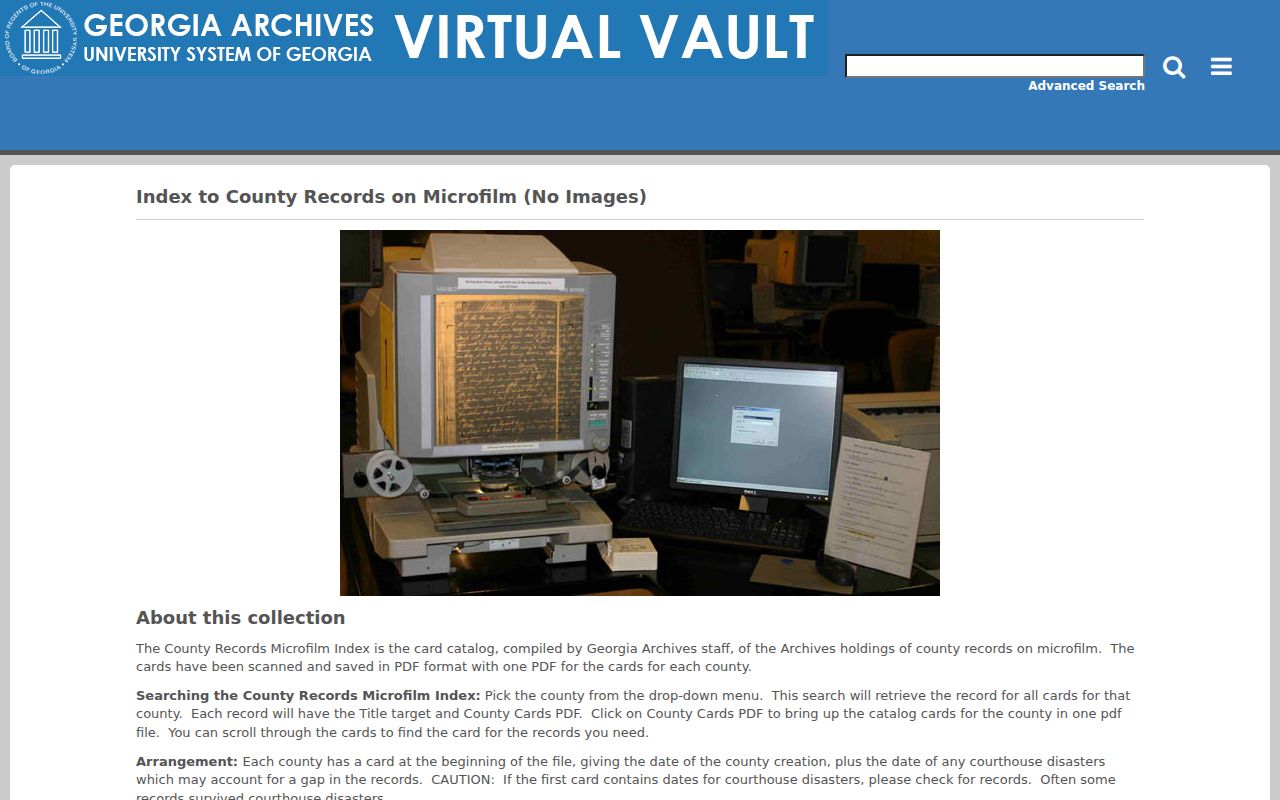
The finding aid is a locator for older record groups. You still need to verify the relevant book, date span, and surviving pages. Contact the Clerk with the last book and page. Include the names, an approximate recording date, and the legal description. The office sits at 225 Pine Avenue, Suite 126 in Albany. Public hours run Monday through Friday, 8:30 a.m. to 5 p.m. A courthouse terminal, a written request, or a vault search all work as fallbacks. Ask the Clerk about certified copy charges before ordering.
Dougherty Tax Digests Bridge Gaps
An old tax digest can place a name beside land during a year when the deed trail stalls. The Georgia Archives finding aid confirms a Dougherty County tax-digest series covering 1881 through 1884. Its fields list owner, militia district, valuation, exemption, address, and taxable value. That makes a digest useful supporting evidence. It helps most where an old street name no longer matches the modern situs address. Still, a digest is not a conveyance. It can point you toward the next deed book, estate file, or name variant, but only the deed chain establishes the recorded order of transfers.
Probate Breaks a Dougherty Chain
Death can break a tidy buyer-to-seller pattern. The Dougherty Probate Court estate file may hold a will, an executor or administrator, heirs, an inventory, a petition to sell land, and a final distribution. The statewide estate search offers a Dougherty County choice plus deceased-name, deceased-date, and filed-date fields. Search the Clerk index next. Look there for an executor deed, administrator deed, deed of distribution, quitclaim, or other recorded conveyance. Older estate files are being digitized. If a file is absent online, the court asks researchers to call 229-431-2102 or email docoprobatecourt@dougherty.ga.us and allow one to two business days for a reply. Probate explains a transition; it never replaces the recorded deed.
Plats Rename Dougherty Parcels
Working backward through Dougherty County property records sometimes hits a parcel identity change. A lot split, recombination, vacation, or revised plat can quietly rename the land. Trust the legal description instead. Match subdivision, lot, block, plat book and page, acreage, and metes-and-bounds text. Do not force every former owner under today's parcel number.
The Clerk portal holds plats. GSCCCA adds name plus book and page Plat Index modes. One caution applies. A preliminary subdivision plan is not automatically the final recorded plat. When a shared drive, easement, or shifted lot line matters, follow the recorded plat reference. Then return to the deeds under the earlier description.
Dougherty History Needs Corroboration
Formal indexes are not the only thread. Dougherty County Public Library genealogy material, local directories, newspapers, obituaries, and census sources can tie a person to a place. That context sometimes surfaces a spelling variant or estate date that unlocks the deed records. Remember what these sources actually show. They often describe occupants rather than legal owners. Keep them in a separate evidence column. Only a deed, probate transfer, or matching legal description should decide. That is what places a name among the property's previous owners.
The library route earns its keep in other ways too. Handwriting or an index abbreviation can hide a familiar surname. A directory shows how a street name was used in a given year. An obituary may name an executor or a married name. Each clue still has to travel. Carry it back to the Clerk or Probate Court. Test it against the formal property records. If the record does not link the person to the same legal tract, label the clue unresolved. Do not insert it into the ownership chain.
How Deep Dougherty Records Reach
How far back can a Dougherty County property search actually reach? No single office publishes one clean earliest year for every ownership record. The honest answer is source by source. Current deeds sit in the local portal. Statewide regular indexing runs from 1999. Older material is still being loaded for 1993 through 1998. Deed-book, probate, and tax-digest runs vary across county and archival custody.
A thorough stopping point records why the chain ended. Note whether the barrier was an unpublished online cutoff or a changed legal description. It may instead be a probate event or an unreadable reference. It could also be an archival volume that must be inspected in person. That audit trail makes later work repeatable. It also keeps uncertainty from hardening into an invented former owner.
In-person or written Clerk requests work best with full detail. Provide the county and both party names. Add an approximate date, instrument type, and the parcel's legal description. Include book and page if known. The local portal lists its remote data and images as free. Certified copies and staff searches may follow a different schedule. The county publishes no certified-copy price online, so ask before ordering. Be sure to distinguish a research copy from a certified instrument. A formal purpose demands the real thing.
Lawful use. Trace former owners for house history, estate work, and property diligence. Never use a record trail to stalk, harass, or harm someone.