
Dougherty Deed Types on Record
Dougherty County deed records document that an instrument was presented and entered into the real-estate system. The label on a deed is only a starting point. What the instrument actually transfers depends on its wording, the legal description, any reservations, and the filings that came after it.
| Deed Type | What It Does | Common Use |
|---|---|---|
| Warranty deed | Conveys the stated interest with title promises in its text | Ordinary sale transfer |
| Quitclaim deed | Conveys whatever interest the grantor has, if any | Interest cleanup or family transfer |
| Executor or administrator deed | Conveys through an estate representative | Estate administration |
| Tax deed | Records a transfer arising from a tax-sale process | Delinquent-tax property |
| Corrective deed | Corrects an error stated in an earlier instrument | Name or legal-description correction |
A deed is not the same thing as a lien or security instrument. A deed conveys an interest. A lien or security deed can burden the property without transferring the same ownership stake, and a release may later clear that recorded claim. Check the Clerk index for every related instrument.
Dougherty Clerk Real-Estate Index
The Dougherty Clerk real-estate index is the local search point for deeds, liens, plats, and images. The portal makes remote data and images available without charge. It also advises trying every spelling variation. That tip helps when initials, marital names, estates, trusts, or business suffixes shift between deeds.
The portal posts current-through notices for its records. Deeds run through August 24, 2026, liens through August 26, and plats through August 12. Treat these as rolling updates rather than permanent coverage promises. The local historical start date is not published.
The official Clerk real-estate search page displays the entrance to the index. It offers a quick visual confirmation before searching.
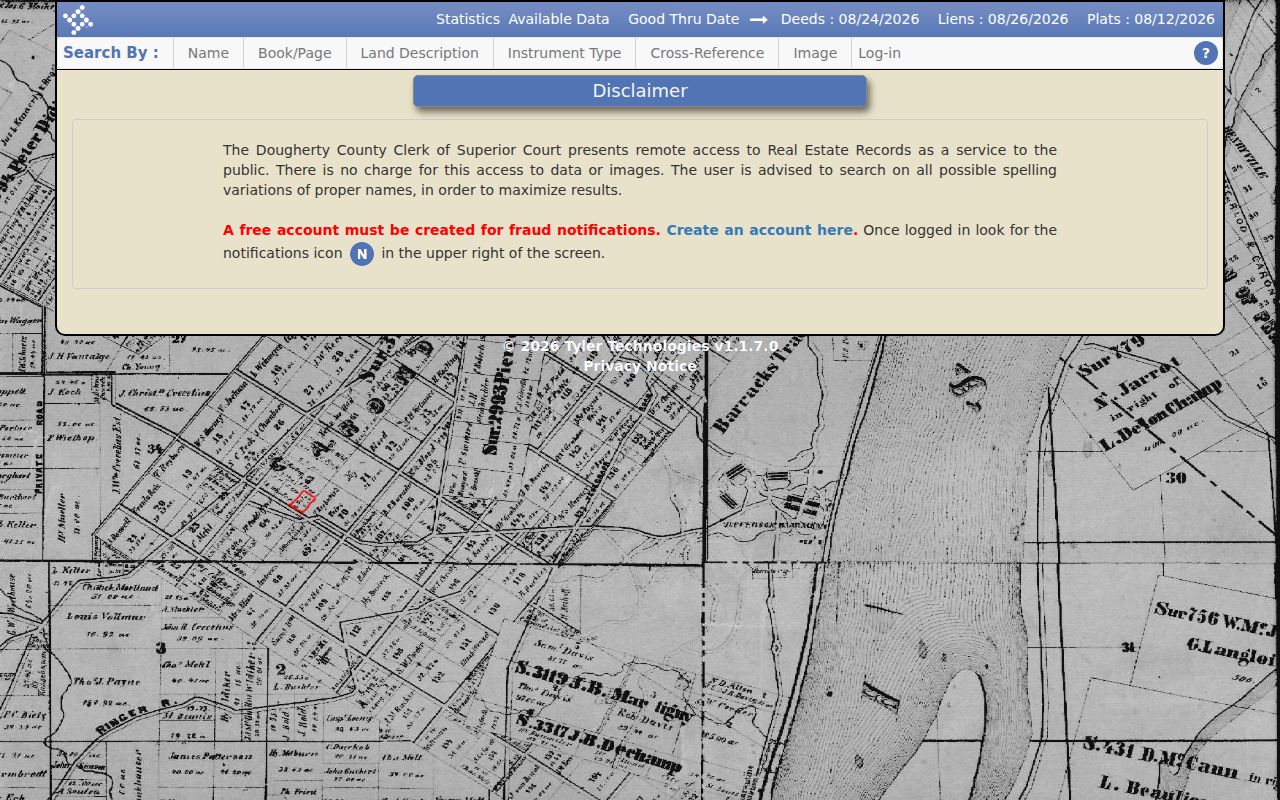
Note: Read the live date notice on the Clerk's site, because newly recorded instruments may post after any earlier view.
Verified Dougherty Index Controls
The Tyler platform that Dougherty County uses does not publish its field labels in plain view. Guessing labels from another county's setup would invite error. So the table separates two things: what is visible now, and what must be confirmed live in the system itself.
| Index item | Verified status | How to use it |
|---|---|---|
| Local name and record fields | Labels not captured | Read the rendered county form |
| Data-through dates | Visible | Judge whether a recent filing may not yet appear |
| Spelling-variant warning | Visible | Repeat party searches under alternate forms |
| Document images | Free remote notice visible | Open and read the instrument, not just the index row |
The statewide GSCCCA search confirms Georgia search modes: name, book and page, property search for participating counties, and instrument type under account rules. Treat it as a cross-county fallback for deed records. Do not treat it as proof of any local Dougherty field.
Follow Dougherty Grantors and Grantees
A grantor-grantee index sorts conveyances by the parties named in each deed. Begin with the newest owner clue you trust. Then follow each acquiring deed backward through the deed records. Keep the legal description next to the names at every step, because a common surname can pull the property search onto the wrong tract or parcel.
- Find the current owner's acquiring instrument with that owner listed as grantee.
- Record the grantor, date, instrument or book and page, and exact legal description.
- Search the grantor as an earlier grantee and compare the land description before accepting the match.
- Repeat until the index ends, a probate transfer intervenes, or the deed points to an older book.
- Grantor
- The party that conveys the stated interest.
- Grantee
- The party that receives the stated interest.
- Chain of title
- The linked sequence of recorded conveyances for the same land.
- Book and page
- A traditional location reference for a recorded document.
- Instrument number
- A unique filing reference used to retrieve an indexed record.
Dougherty Records Beyond Deeds
A sound chain of title reads the instruments surrounding each deed. Liens, releases, plats, and security instruments all shape the record trail. A release must be located on its own; never assume one from a paid balance. A revised plat or a lot split can explain why one legal description stops matching the next deed in the chain.
Business and trade-name filings can decode an entity name appearing as owner of record. Probate records can explain an executor, administrator, or estate transfer. Each of these supports the inquiry. Still, the recorded deed and its linked instruments remain the core land evidence.
The 1999 Georgia Benchmark
Dougherty County deed research runs through the state index in most cases. Georgia's consolidated GSCCCA property index began regular transaction coverage on January 1, 1999. Older material from 1993 through 1998 is still being folded in. Treat 1999 as a statewide benchmark. It is not a promise that every Dougherty County deed book is fully digitized for those earlier years.
The GSCCCA Real Estate Index lets you search a single county, a region, or the whole state. Name, book-page, and other modes are available under its access rules. Account tiers such as limited, regular, premium, and single-use carry different terms. Check the local Clerk's images first, since Dougherty County offers them remotely at no charge.
Older Dougherty Land Books
Dougherty County was created from Baker County in 1853, with portions of Worth County transferred soon after. Early land research can therefore lead into Baker or Worth deed records when a transaction predates the modern boundary. Preserve historic land-lot descriptions exactly as written.
When the web index ends, turn to the Clerk's courthouse terminal or vault, then Georgia Archives microfilm and county-card finding aids. The Archives also holds tax digest and probate material that can support identity and time clues. The earliest Dougherty tax-digest run covers 1881 through 1884. Do not blame a missing deed on a courthouse disaster without book-level evidence, because no such loss is documented for the county.
The Georgia Archives county-card collection illustrates the finding-aid route for older deed books.
A finding aid points toward surviving series and formats. It is never a substitute for the recorded deed page itself.
Georgia's Filing Activity Notification System, called FANS, lets anyone subscribe for notice when a matching property filing reaches the statewide system. The service is prospective only. It can flag activity after the Clerk transmits an index entry, but it cannot prevent a filing, guarantee the match is complete, or insure title.
A free account is required. After sign-in, the notification control creates the subscription. The official FANS access screen shows where that account-based process begins.
The alert screen is only a monitoring tool. When a filing looks unfamiliar, the Clerk's recorded deed image remains the source to inspect.
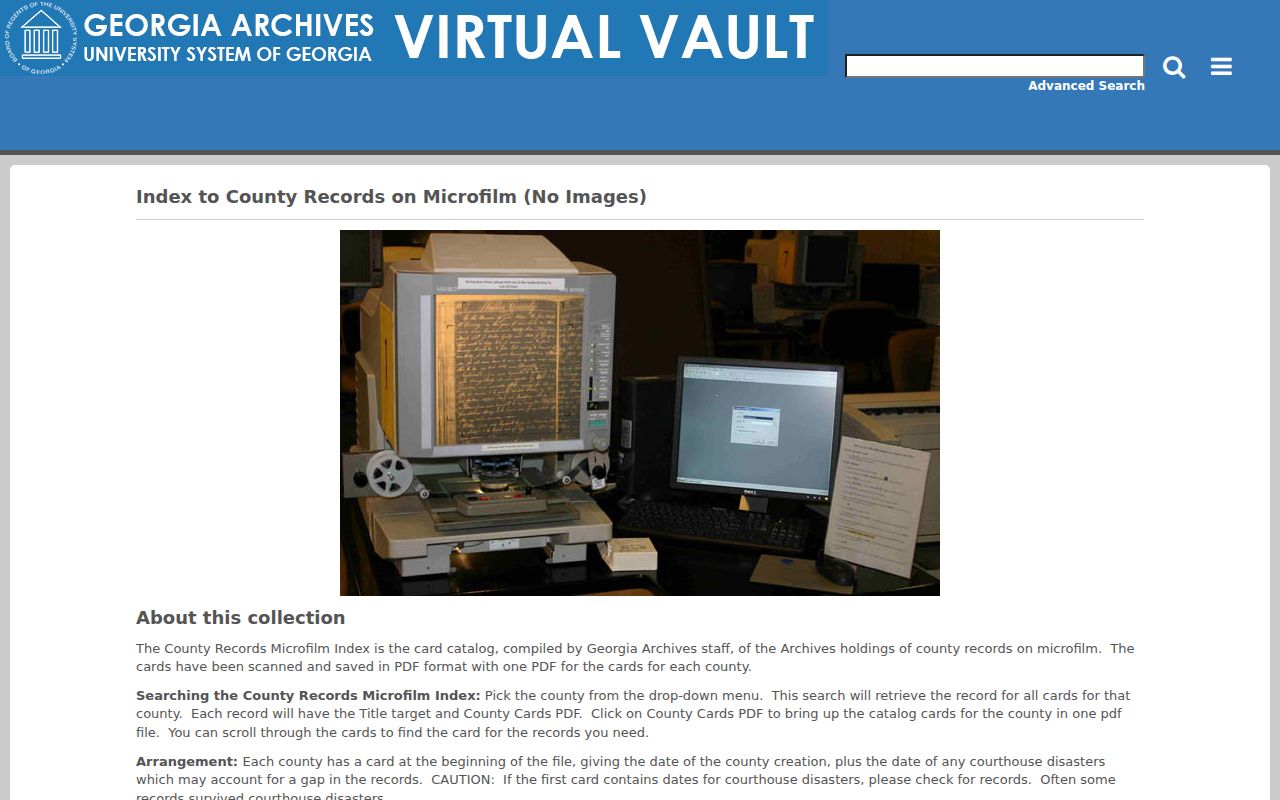
A finding aid only points you toward the surviving series and formats. It is no substitute for the recorded page itself.
Dougherty Filing Alerts
Georgia's Filing Activity Notification System, called FANS, lets anyone subscribe for notice when a matching property filing reaches the statewide system. The service is prospective only. It can flag activity after the Clerk transmits an index entry, but it cannot prevent a filing, guarantee the match is complete, or insure title.
A free account is required. After sign-in, the notification control creates the subscription. The official FANS access screen shows where that account-based process begins.
The alert screen is only a monitoring tool. When a filing looks unfamiliar, the Clerk's recorded deed image remains the source to inspect.
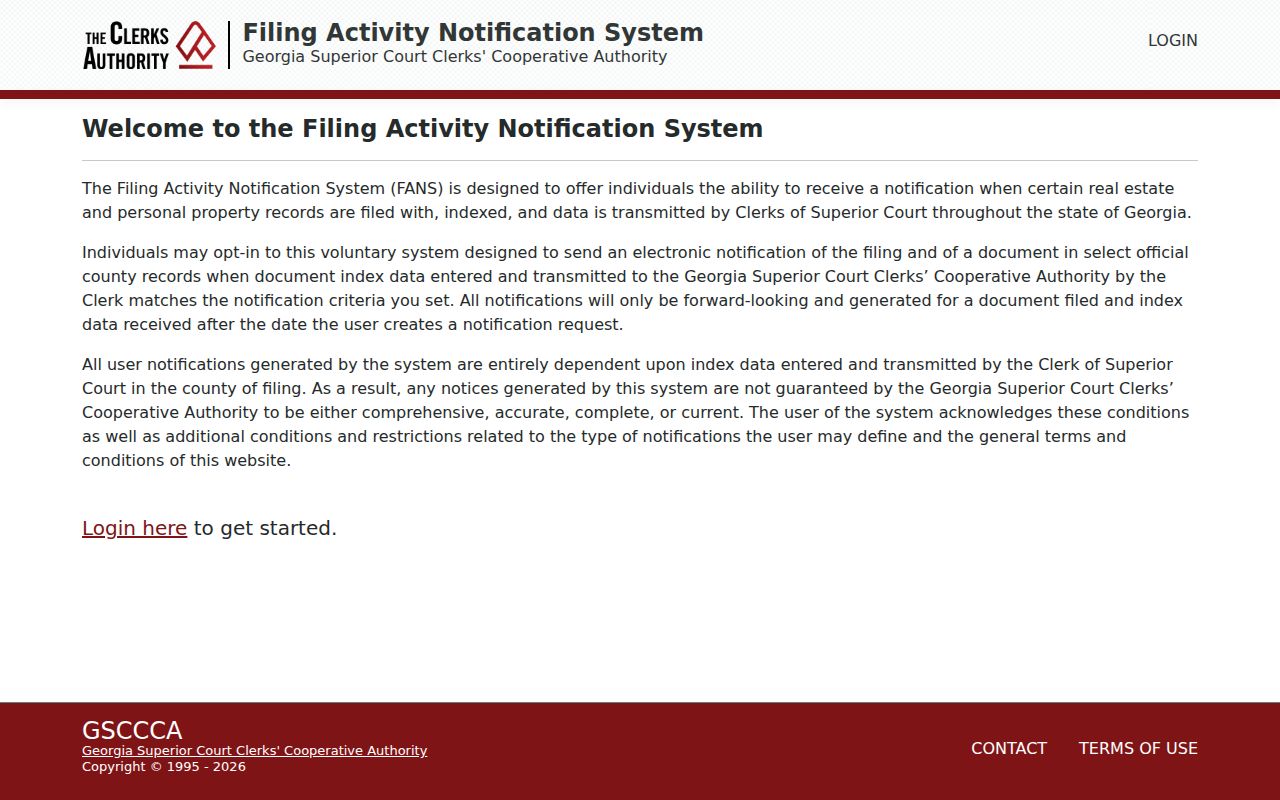
The alert screen is only a monitoring tool. When a filing looks unfamiliar, the Clerk's recorded deed image remains the source to inspect.
Obtain a Dougherty Deed Copy
Start in the local Clerk portal. That is where the free image notice sits. Certified copies, courthouse printouts, and special searches carry a charge, and the office publishes no certified-copy fee schedule, so ask the Clerk for the current amount before ordering. You will find the office at 225 Pine Avenue, Suite 126, Albany, open Monday through Friday from 8:30 a.m. to 5 p.m.
A written or in-person request works best. State Dougherty County plainly. Include all party names, the approximate recording date, the book and page or instrument number, and the parcel or legal description. If the request reaches into the broader backward chain, the previous owners research explains how to carry each grantee into the prior deed.
Recorded, not guaranteed. Dougherty County deed records show filed instruments, but they are not a title opinion and may not reveal unrecorded interests.
Dougherty Deed Record References
Book and page references anchor a Dougherty County search. Copy them exactly as displayed. A legal description may use lot and block, a subdivision and plat reference, acreage, land lot and district, or metes and bounds. Metes and bounds traces a perimeter. It runs through bearings, distances, monuments, roads, streams, or adjoining owners.
Compare the deed description with the prior deed and plat before trusting the chain. One tract can carry both keys. The assessor parcel number is a tax-map key. The deed's legal description is the recorded conveyance language, and a later tax-map update never rewrites the old instrument.
A book reference can also push the search past the online index. Give the Clerk the exact citation when requesting a vault, terminal, mail, or certified-copy search. Names alone can mislead. Clear references keep a common party name from pulling the wrong document.
Dougherty Deeds and Estate Transfers
Estates can interrupt a tidy run of sale deeds. Dougherty Probate Court maintains the estate, executor, administrator, and related files. When an instrument names an estate representative, tie that capacity to the probate file. Then return to the recorded conveyance.
Georgia Archives holds Dougherty probate records from 1800 through 1923 and wills from 1836 through 1933, though those ranges mark archival holdings rather than an online deed cutoff. The files can identify heirs, representatives, or proceedings that explain why a prior owner vanishes from the normal name pattern.
Search the decedent, the estate name, the executor, the administrator, and the later grantee. Preserve middle initials and representative titles. Probate evidence explains authority and succession, while the Clerk's recorded instrument documents the land transaction placed in the real-estate record.
Names can match while the land does not. Stop there and compare the legal description. Estates can involve several parcels, partial interests, or distributions that never follow one sale-style row. Keep the representative title with the signer.